The life of a litter bin
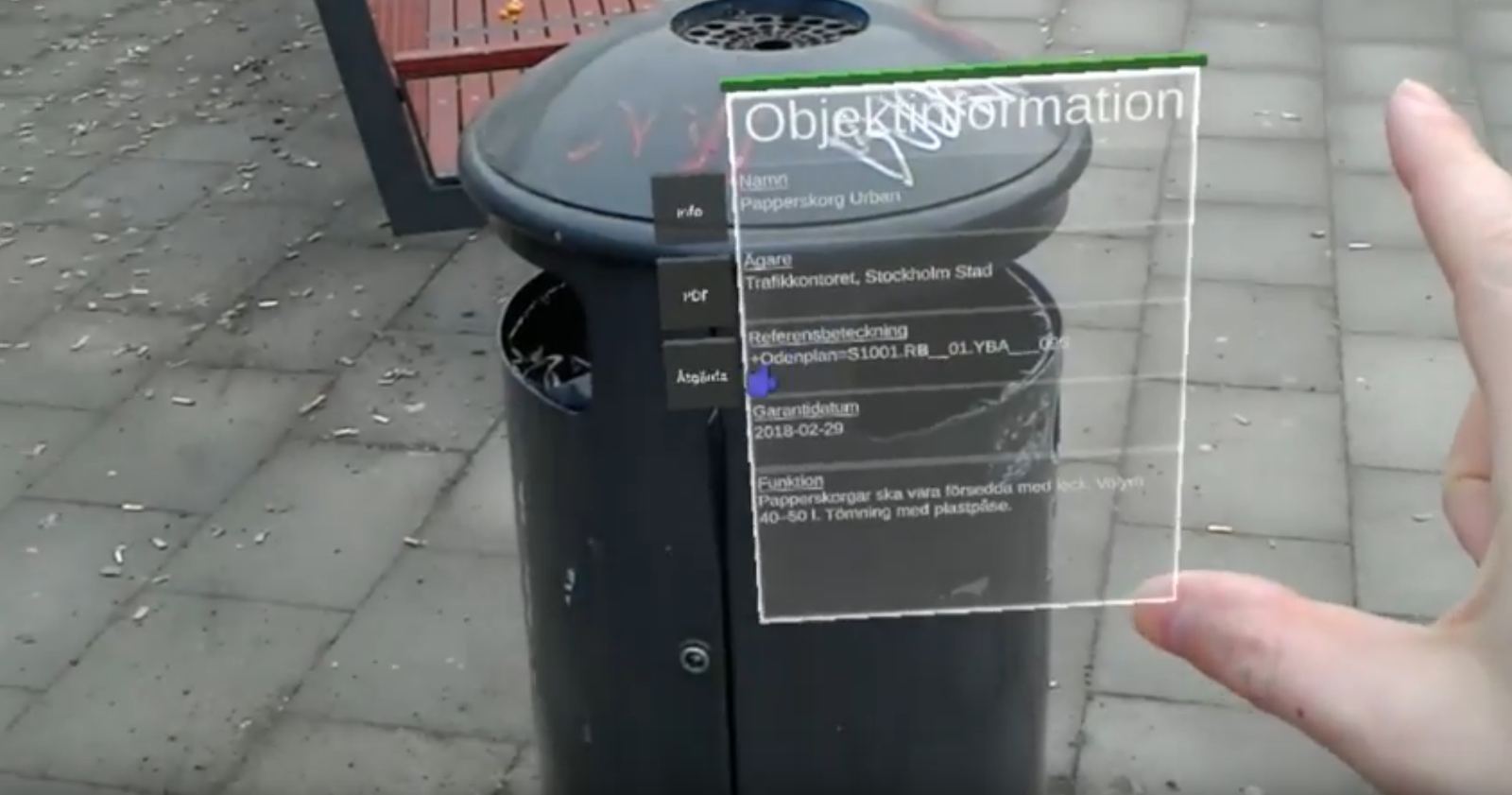
As a litter bin, life is sometimes rough. Consumer demand is uneven, but if you fail to serve in the critical moment, for example because the bin is stuffed, that is the starting point of a string of complaints from citizens in the area. Litter floating around, too infrequent emptying schedule, and if the bin needs servicing or replacement, it is seldom clear whose responsibility that is, even to the maintenance team. If the bin sits on public land, but is adjacent to the metro station, is it the responsibility of the city, the metro station, or a private contractor hired by one or the other?
Model everything once
It sounds so obvious, but everyone who has been part of a quality project knows that information grows stale at a pace where even the greatest effort will fail, if not immediately, then over the course of the natural life of the product. What if there was a way to both model just the information needed, and refresh it, when it needed to?
In 2018 Svensk Byggtjänst ran a project within the Smart Built Environment program to explore this problem, using the framing of the newly developed classification system CoClass, that was the planned successor of the aging BSAB standard. In “CoClass and LOD”, one strand was to explore how that information could be reached and kept current where the thing itself stands, and the idea was to use Augmented Reality as a means to overlay information spatially. The Odenplan area in central Stockholm was chosen as the physical testing ground for the project.
Everything in the project was limited scale but carried all the signs of a typical building information management assignment; multiple structures across a large physical area, different lifecycle stages, different owners and distribution of responsibility. Similarly, the data sources were the usual assortment of capture fragments; overview plans, laser scans, manual inventory lists, all captured at different points in time with different levels of accuracy. Even the 3D geometry was fragmented; a portion of the project was spent reconciling the different 3D models of the area and adding the missing pieces into a single BIM model. CoClass was then used as part of the alignment process for these information sources, using functional object classes with defined properties throughout, linked to material and product data — making the classification the index, and the 3D model the view onto it.
LOD in building information management
While the term LOD is used across many industries with adjacent but nuanced interpretations, in building information management it has carried two at once. Level of Detail came out of cost estimating — how definitive the information about an object is, which is a question about quantity. Level of Development came from the American Institute of Architects — how reliable that information is, without regard to what it will be used for, which is a question about quality. The same three letters, one asking how finely a thing is drawn and the other how much about it is actually settled.
The project’s own video narration offered a third reading, Level of Definition — what level of detail is both requested and defined. That is British usage rather than Swedish, and the fact that three expansions were in circulation at once is a fair measure of how unsettled the term was.
However, they do not separate the geometry from everything else. A Swedish pre-study running alongside the project found that LOD does not distinguish the level of detail demanded of geometry from the level demanded of properties. And the most common misreading in practice was to take the requirement as geometric detail alone.
Level of Information Need
That is the gap the project proposed to close. To avoid both overworking the information capture and missing key pieces of it, geometry and properties should be designated separately: a three-digit information level. The first digit is the lifecycle stage — feasibility, planning, design, production, use, demolition. The second is how far the thing has been pinned down: by function, by type, or in detail. The third is what the information is actually for, on a list that runs from procurement and costing through transport and assembly to operation and maintenance. To line up with the coming European standard the concept was given the name LOIN, Level of Information Need, leaving LOD to revert to its original meaning of level of graphical detail.
LOD says how finely a thing is drawn; LOIN asks how much is needed, and what for. A bin in service, pinned down in detail, for the purpose of operation and maintenance, is a 539 — and nothing in those three digits is about how well its shape is modelled.
The caretaker’s round
Four cases were scripted for the demonstrator, across three roles. An architect, or the city’s beauty council, could say “After” to see the proposed model and “Before” to put back what stands there today. A market trader could see which pitches on the square were free, and read the terms of whichever one they looked at. The remaining two were the caretaker’s, and those are the ones that answer the question the bin started with.
On the round, any object carrying information drops a tooltip when the caretaker looks at it, and loses it again when they look away. Hold the gaze and step closer and a menu opens: who was last here and what they did, a data sheet from the engineering consultants, the CoClass data as a list, and a button to report a fault. Pick what is wrong with it, and the object turns red.
Clearing the fault is the same loop run backwards. Say “View open issues” and every tooltip in sight appears, red or green. Walk up to a red one and the menu says what it was reported as, by whom, and when. Press Fixed and it turns green: fixed by you, today.
The process is straight forward. It is a list of properties attached to a thing, with a note of who touched it last. But it is the answer to the bin’s problem, and the answer is not a better emptying schedule but an object that knows what it is and can say who saw it most recently.
Findings
The project showed what timely access to well curated information about almost anything, even a litter bin, would be worth. It was also explicit about the limitations of the project. Long-term asset information management was outside its scope, and the report named the three things that would have to be solved for it: the quality of the data, the identification of objects, and the maintenance strategies that keep both true. Getting stakeholders to harmonise their classification is the first of those steps, not the last.
Which puts the bin back where it started. Knowing that it is a litter bin, owned by the city traffic office, carrying a reference designation and a warranty date, is not the hard part; a classification can hold all of that. The hard part is that somebody has to keep saying so, for as long as the bin stands there.
Sources
- Klas Eckerberg & Jan-Olof Edgar, »CoClass och LOD: Livscykeltest av CoClass – Nya generationen BSAB«, Smart Built Environment, 2018
- Manfred Otterheim, »AR visualiserar information från CoClass«, Byggkoll, Svensk Byggtjänst, 27 april 2018
- Håkan Norberg, »Förstudie: Detaljeringsnivå för informationsleveranser«, BIM Alliance / SBUF, 2017-01-11